R.H. Ives Gammell (1893-1981) was not only a remarkable painter, but a writer and, most importantly, a strong advocate and teacher of traditional art during a time when modern art was threatening its existence. This post pulls heavily from his own writings to share his life's journey as found in "Transcending Vision," a biography by his goddaughter, Elizabeth Ives Hunter and Gerald Ackerman.
Childhood Aspirations
As he wrote: "The idea of becoming a painter came to me a few weeks before my tenth
birthday. I had already been drawing birds for a couple of years and my
laudable ambition then was to be a second Audubon. But in my tenth year
an attack of scarlet fever with protracted after-effects kept me out of
school for several months, and I began to frequent an excellent private
library, the Providence Athenaeum, to study the works of my favorite
author."
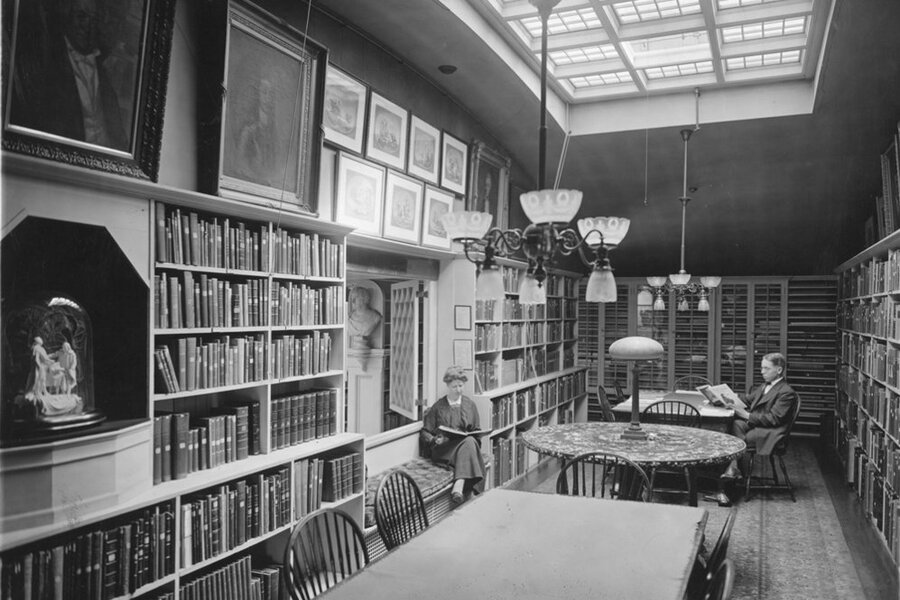 |
| Providence Athenaeum Art Room, 1897 |
"The
Audubon volumes were kept in a rather dark alcove on the second floor
of the building and I distinctly remember a cloudy day when, in search
of better light, I discovered a room offering very superior advantages,
which included a comfortably upholstered sofa. From that day on I
carried my ornithological books to these agreeable surroundings. Officially
entitled 'the Art Room', as I presently discovered, the place housed a
comprehensive collection of books on painting, which were to be my
delight for many years to come. But they held no interest for me until a
day, also vivid in my memory, when I
chanced to sit at a table bearing current numbers of various art
publications and curiosity impelled me to leaf through a tan colored
magazine at my elbow entitled 'Masters in Art'."
"There were few masterpieces to be seen in our art galleries before 1914. The Boston Museum of Fine Arts owned half a dozen fine paintings, the greatest of them being, then as now, Velazquez's 'Don Carlos and His Dwarf'. Until 1910, about the only pictures of the first rank by great masters in the Metropolitan were, with the Rembrandt of a man in a black hat, the admirable Vermeer of 'A Lady Opening a Casement', not yet seriously damaged by ruthless cleaning, Van Dyck's superb 'Duke of Lennox' and two excellent portraits by Hals."
"A major event occurred while I was twelve when Mrs. Gardner began her
practice of admitting a limited public to her palace [now the Isabella Stewart Gardner Museum: https://www.gardnermuseum.org/]. I think she sold two hundred tickets a day for
two weeks every year. But the greater change
came with the appearance of the Altman Collection and J.P. Morgan's
magnificent gifts at the Metropolitan around 1914. It was a barren world
for an art-minded boy to grow up in before that."
 |
| Isabella Stewart Gardner Museum, 1902 |
"Perhaps even more striking is the contrast between the present attitude toward painting as a profession and the attitude prevailing in my boyhood. A strong desire to paint on the part of a growing boy was considered an unfortunate taste, to be ridiculed or at best condoned but certainly not to be encouraged."
"It was almost unthinkable that a normal, up-standing young man should seriously consider taking up painting as a profession. Among the well to do such a thing was thought not quite respectable whereas families in less easy circumstances rightly considered it a bad financial risk."
"Everything was done to discourage such unfortunate proclivities. While literature was an accepted topic of conversation in the more cultivated segments of conventional society the fine arts were ordinarily dismissed with a few stereotyped remarks. One or two communities, at Cornish and at Dublin, New Hampshire, for instance, seem to have been striking exceptions to this pattern."
"Almost inevitably American art students went abroad to escape this arid intellectual climate and many of them continued to live in Europe for most of their lives. I took it for granted that I would study in Paris for several years and probably spend much time abroad after that."
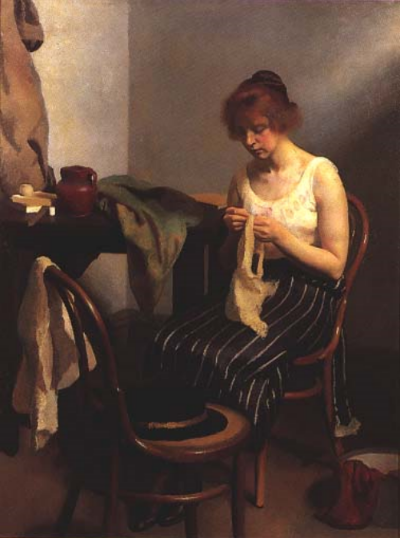 |
| "The Seamstress" by RH Ives Gammell |
Ives Studies with William Sargeant Kendall
"I realized that I needed professional guidance...so my mother suggested William Sargeant Kendall, an artist who had painted her portrait some ten years earlier. The choice was a fateful one and, on the whole, fortunate. I remember vividly the day I knocked on his studio door. It was opened by a man in a blue painting smock whose solemn face and
intense manner took me aback. When he heard that I wanted help he
assured me that he was never too busy to help anyone really in earnest
about painting and that he would gladly look at my work on the following
Friday afternoon."
"What he said about my drawings is not relevant at this point but he did not conceal that he found them exceptionally interesting. Whenever I showed Kendall some of my work he invariably assumed a funereal expression, drew down the corners of his mouth and delivered his verdict in a strained, portentous voice. Although I soon began to have my doubts about the pontifical manner put on for my benefit I never lost my awe of Kendall and I have retained my respect for his artistic integrity to this day."
 |
"The Interlude," 1907
by William Sargent Kendall |
Discussing my future with my mother, Kendall asked the bewildered lady whether I had a very strong constitution. When she answered in the affirmative he solemnly commented, 'That is fortunate. A painter's life is a killing life.' He loved to present painting as an austere and somber calling, a kind of martyrdom, with himself as one of the victims. Other painters of my acquaintance have recognized the exceptional strain involved by an unremitting effort after excellence in a heartbreakingly difficult art but their attitudes were always tempered by a delight, an utter joy in the practice of their craft. Paxton used to murmur, 'Painting is so difficult none of us would keep at it if it weren't more fun than anything else in the world!'
"I remain deeply indebted to Sergeant Kendall for two things. His dedication to art as a high and important calling evoked an immediate response in my own heart. As a painter Kendall was utterly uncompromising in his attitude towards excellence and in his contempt for the trivial, for the opportunistic or the mercenary. He also had the true artist's humility before great art. These traits are hallmarks of the real artist and without them even the most brilliant gifts will not gain a painter admission to the kingdom. Secondly, Kendall sent me to the painters best qualified to give me the training I needed. I have never ceased to be deeply grateful that Sargeant Kendall sent me to Joseph DeCamp for advice."
 |
| "Alison" by William Sargeant Kendall |
"I had grown up in the belief that Paris was the place where you learned how to paint. Kendall rightly told me it no longer was. The Boston Museum School seemed to provide the best training. Kendall considered the leading Boston painters to be the most accomplished in the country."
 |
| Philip Hale's class at the Boston Museum School, 1911 |
"I have never forgotten how he sized them up. He called DeCamp the best trained. Tarbell, a finer artist, was not as well trained while Benson, even less well trained and a weak draftsman was still a distinguished picture maker. He had reservations about Philip L. Hale whom he had known as a student in Paris, full of strange theories. He had not met Paxton at the time and I do not remember that he commented on his work. In his view these men made up an impressive group and he felt that an art school in their hands must be a good place in which to work."
Advice on an Art Education
"So, Boston having been decided upon, the next problem was to persuade my parents to let me start studying painting immediately after graduating from boarding school, without benefit of college.
"At what age should a would be painter abandon the ordinarily prescribed course of studies to concentrate on his professional training? The professional painters whom I was able to consult were unanimous about one thing. If I was to become a competent painter I had no time to lose. I would have to begin at once working six to eight hours a day, week in and week out, learning to draw. The delay at this time necessitated by four years of college would cripple my career."
"Once he had accepted the idea that I was going to be a painter my father was prepared to follow the best professional advice about my training. We was also prepared to believe that this advice could be had from Joseph DeCamp, then at the height of his reputation. DeCamp had painted Theodore Roosevelt and a number of prominent men whom my father knew. My father wisely agreed to let me work at painting for one year, provided DeCamp thought me sufficiently talented. If at the end of that year my progress did not, in DeCamp's opinion, warrant my continuing I was to go to Harvard, for which place I had already passed my examinations."
_-_Worcester_Art_Museum_-_IMG_7587.JPG) |
| "Sally" by Joseph Rodefer DeCamp |
"So an appointment was made with DeCamp and one afternoon I knocked on his studio door carrying a bundle of drawings under my arm. Many years have passed since that fateful day but several details have remained fixed in my memory. I vividly recall looking down from the balcony of the high studio and hearing DeCamp's cheerful, 'Come on down, son.' There followed a leisurely examination of my drawings punctuated by an occasional rather quizzical comment and, finally, a few words of encouragement. Yes, there was a chance that I might develop into a painter but first I would have to 'cover barrels of paper and use up buckets of paint."
"Thirty years later DeCamp's widow told me that her husband had come home that afternoon and said, 'A kid walked into my studio today who is going to be a better painter than any of 'em.' So I was to enter the Museum School in the fall of 1911."
Studies at the Museum School, Boston
"I entered the Museum School in the fall of 1911. The curriculum was rigid. A year of more of drawing 'from the antique' [casts] under William Paxton and two solid years of 'life drawing' under Hale were required before taking up painting."
 |
| Cast Drawing Class, Cornell University |
"Then came a beginner's painting class under Frank Benson, and intermediate class painting from the half-nude under Tarbell and, finally, "advanced painting" of the nude figure, again with Tarbell. The entire course was supposed to take seven years."
"I no longer remember just why I attached very great importance to skipping Paxton's antique class. For one thing I had done a good deal of cast drawing with Kendall. For another I had heard derogatory things about Paxton. I was wrong. True, this sort of rigid curriculum in which a student graduates from one class to another was a major defect of the nineteenth century art school system. An art student should be made to work at whatever his immediate development requires at any given time, shifting back and forth from drawing to painting, from still life to landscape or to figures out of doors as his teacher decides."
"For centuries drawing from statues, or from plaster casts of statues, was considered the ideal starting point for a number of excellent reasons. Casts do not move, their uniform whiteness simplifies the problem of modeling and prepares the student to cope with the great complexity of values he will find in the human body, and the stylized forms of antique statues educate his eye. There is no substitute of comparable worth."
"But it is a mistake to treat cast drawing as drudgery to get through with and then to put away with other childish things. There are many lessons to be learned from drawing and painting from casts which completely escape a beginner. A student will have a far better understanding of what he is doing if he intersperses his cast work with life drawing and his painting with occasional returns to cast work."
In January of 1913, Gammell heard that Tarbell, Benson and Paxton, along with several other prominent faculty members, had submitted their resignations to the Museum School, effective in June. Gammell decided that the most productive course would be to go to Paris, which was considered the best place to study painting at the time.
Studies in Paris
In his own words: "So one October afternoon of the year 1913 I got off the Havre boat train at the Gare Saint Lazare and found myself in Paris at last: 'Paris cite de joie! Cite d'amour!' as I had heard it sung of in the opera 'Louise'. This was the moment I had dreamed of for eight years and had visualized as the beginning of my life as an artist. This was it!
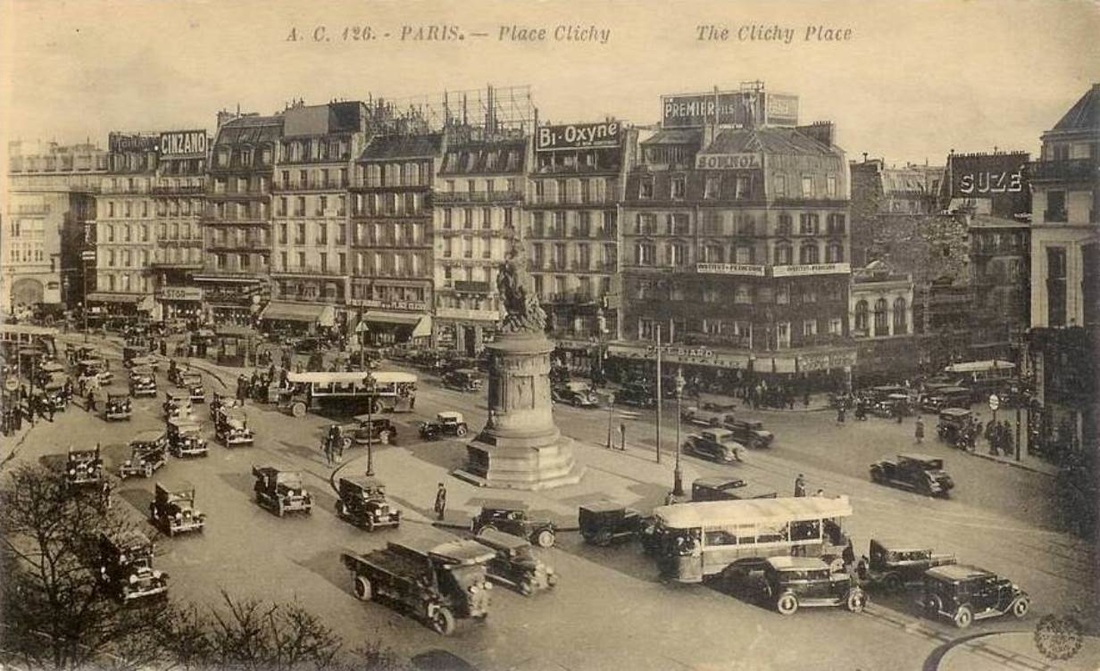 |
| Place Clichy, Paris, 1913 |
"I remain deeply grateful for that glimpse of Paris as it was before the fateful assassination took place at Sarajevo. I was fortunate to have had it when I was twenty years old. It broadened my outlook in many ways and it left vivid impressions of a way of life which very soon became almost as remote as that of the Ancien Regime itself."
"And, superficial though it was, my observation of the final phase of nineteenth century French painting gave me a perspective which few of the American painters of my generation ever acquired. All of my subsequent thinking and painting has been to some extent colored by this early contact with the civilization of France."
"I planned to draw every morning at Julian's and to paint from models in my little studio every afternoon. My American friends urged me to join the Atelier Baschet where most of them were drawing. The atelier of old Jean Paul Laurens was also at Julian's and the celebrated name attracted me. But the friends assured me that the great old painter rarely appeared and that the criticizing was done by his two sons. So to Baschet I went."
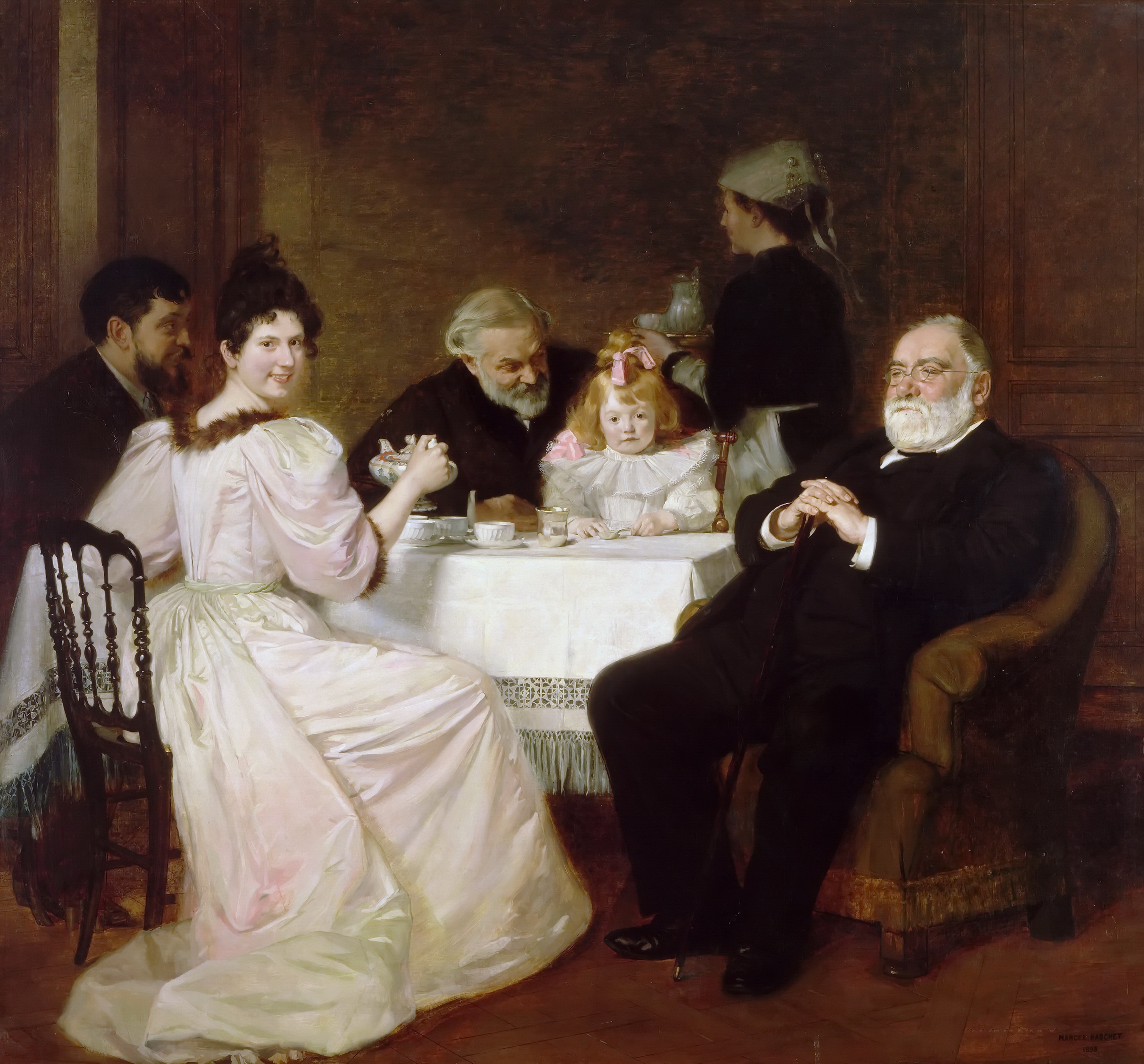 |
Marcel Andre Baschet . "Family Gathering at Madame
Adolphe Brisson's |
"The Atelier Baschet took its name from Marcel Baschet, the titular head who for some reason was almost never there. I think I saw him twice during the eight months I attended the studio. He seems to have been pretty much the official portrait painter of France in those years, draped in the mantle which had slipped off the aged Bonnat. "Criticisms were given by Henri Royer and William Laparra. Laparra was a far more forceful character and he attacked my drawings with a severity which I found stimulating. I still remember his harsh, 'Vous ne savez pas dessiner, mais pas de tout!' ['You do not know how to draw, not at all!"], but he gave me no clue as to how I could escape from my predicament."
"In retrospect I can see that all these French painters represented a stage in a world-wide decline in the art of painting, a phase whose counterpart I observed in Boston a decade or two later. The severe training implicit in the paintings of Gerome, Bonnat, Laurens, Bouguereau and their contemporaries had not been given to their pupils who were turning out greatly weakened versions of what their seniors had done far better. For a time some of these thoroughly mediocre artists exercised considerable authority as teachers and as figureheads of the two official Salons."
"As teachers they merely dispensed minor corrections to large classes of students who naturally benefited very little by that sort of instruction. Ignorant of the rudiments of their art these fumbling practitioners of the third generation finally passed as the representatives of 'academic painting' in the nineteen twenties when they proved easy marks for the snipers of 'modernism' who wished to discredit the criteria of nineteenth century painting in as many ways as possible."
"I have sometimes wondered what would have happened to me had I stayed much longer in the fascinating city, as I had had every intention of doing. I was revolving a number of plans for the following year when the war broke out, and it was with a heavy heart and deep misgivings that I returned to the United States."
Studies with Paxton
"One grey September afternoon in Provincetown I was walking down the long front street watching the white caps whipped up by a strong southwest wind in the harbor when I ran into Paxton. I had never particularly liked the man when he came to criticize for Philip Hale and I knew next to nothing about him as a painter."
"But I was glad enough to talk to him and he was eager to hear about Paris. So we walked the length of the street reminiscing about the glorious city which at the time was seriously threatened by the German invading armies. I told Paxton how much I had hated to leave and also how reluctant I was to go back to Boston and the reconstituted Museum School."
"His parting words to me were, 'If you ever get stuck come around and see me. I might be able to help you out.' I thanked him for the kind suggestion with the mental reservation that going to see him was about the last thing I could ever imagine myself doing in such a case. October found me once more in Boston. I rented a small studio with the idea of working by myself in the afternoons as I had been doing in Paris. It all seemed unutterably dreary after France and my fellow students at the Museum School were no more stimulating than formerly."
"What was I to do? The Museum School no long had anything valid to offer. Paris was cut off by the war for an indeterminate period and I had begun to suspect it was no longer a good place to learn the rudiments of the painter's trade. DeCamp had always been kind, interested and voluble but he had often made it clear that he was too busy to take a pupil. Then I remembered Paxton's parting words in Provincetown. Why not try going to him? So the next morning I knocked on his studio door."
"Gammell's relationship with William Paxton was to last until the latter's death in 1941 and grew into a genuine friendship between the two painters who shared an interest in diverse art forms."
"Paxton came weekly to criticize Ives' work, making sure that the model was available so that nature was immediately available for comparison with the painting in progress. In later years Paxton and Gammell drew from the model on Monday afternoons...Often the afternoon criticisms spilled over into drinks and then dinner at the St. Botolph Club, where the discussion ranged farther afield to art history, music and literature."
In Mr. Gammell's own words: "In any case, I stuck with my plan of getting the most thorough training possible along impressionist lines, impressionism being the only type of painting flourishing at the moment, and then, using that as a basis, to construct a system of my own suitable to my particular purpose."
"I was back in Boston comfortably settled in a good studio on Botolph Street which had recently been vacated by Frank Benson. I would have been greatly surprised had anyone told me that I was to keep it for twenty-two years. I hired a model for the mornings and another for the afternoons. I painted some portraits, for orders began to come in. I painted nudes,. I painted interiors with figures. I painted girls engaged in various occupations."
"And Paxton came in frequently criticizing, correcting, suggesting ways of improving a given composition or of giving unity to a design. He always did these things authoritatively, with complete understanding of the problem in hand and with absolute technical command."
"The great models of mural painting will always be found in Italy and in
France and I made frequent trips to those lands in the post war years.
In Florence I met a man who knew far more about the methods of the great
Italians - Nicholas Lochoff."
"He was certainly an extraordinary figure. A huge bearded Russian, he had been sent to Italy around 1910, I think, commissioned by the Czar's government to copy Italian masterpieces for a museum to be established in Moscow. The Bolshevik Revolution ended commission and stipend together, leaving poor Lochoff stranded in Florence with a studio full of copies and no means of subsistence."
 |
| "The Annunciation" by Ambrogio Lorenzetti |
"I watched the copy he was then making of the
'Annunciation' by Ambrogio Lorenzetti and he showed me copies in his studio. Although I never saw any of these completed copies side by side with the originals they seemed to me remarkable. We examined many paintings together in the Uffizi and the good man came all the way across to the Pitti to see my copy. I found his comments very enlightening and I have ceased to regret the language barrier which prevented my learning more from him."
"When Pietro Annigoni emerged as a major painter on the international scene at the close of WWII, I was hard put to explain his artistic origins. I had been well aware of the absence of any accomplished painter in the thirties who could have taught this admirable craftsman a way of working which had no parallel in this century."
"A biographical notice finally provided a key to the enigma. He had associated with Nicholas Lochoff during his formative years and the learned technician without creative ability had taught the talented Italian lad a tempera technique which Annigoni perfected and made his own. When I met Annigoni he gladly acknowledged his debt to the Russian exile whose most important contribution to art undoubtedly lay in the start he gave to the boy destined to become the only distinguished painter of his generation."
Liz Hunter, one of the authors of "Transcending Vision," writes: "Ives was back in Boston for a few days mid-summer in 1928 and working in his studio when there was a knock on the door.
He answered it and let in a young art student who had heard that he needed models and was hoping to make some money posing. In fact, Gammell needed a model right there and then, so he hired the young man. From that rather mundane beginning grew a personal and professional collaboration that lasted until Valsam's death in 1979."
"Years later I asked my father and Uncle Ives what stood out in their minds about that early meeting. For his part, Gammell said that my father posed well and was just the physical type he needed for the work at hand. In the fall of 1928 when they resumed work, he was delighted to discover that Ted had followed up on some suggestions about readings in literature and art history which had come up in their earlier conversations during the summer."
"Then late in the fall, halfway through a posing session, my father fell into a dead faint on the model stand. Gammell went up to try to revive him and saw a bandage on his leg from which red lines traced upwards under the skin. Ives knew enough to suspect a serious infection which was spreading, and he called his own doctor on the spot. When the doctor arrived he insisted that Ted be taken to the hospital at once where he was admitted. His stay lasted two weeks, but in the end he recovered."
"It soon became clear to both that their temperaments were complementary. Ives was an intellectual by nature and Ted was a pragmatist. As Ted learned more about historic styles in architecture and design he was able to help Ives establish more archeologically correct settings, and he drew well enough to handle the enlargement of sketches and the preliminary lay-in of larger canvases. He delved into costume design and was fascinated by the challenge of fabricating the objects needed for Gammell's concepts. On a practical level, he knew how to drive and had extensive knowledge of Boston and its environs so that he could suggest venues for landscape studies that were unknown to Gammell."
Mr. Gammell's Atelier
"He began to plan his own atelier, since he believed that the best way to teach painting was in an intimate and direct way. He felt that he was obligated to do his best to pass on what he had been taught and had discovered over his 35 years in the field."
 |
| R.H. Ives Gammell |
"In his book, "Twilight of Painting, he criticized bad teaching and what he saw as the impossible art school system...and he understood that he must put it to the test himself. His goal was to 'try and teach a handful of the really talented kids the difficult art of painting.' For if he did not do this, he would be subject to Leonardo da Vinci's criticism, 'The supreme tragedy is when theory outstrips performance.'"
"Ives and Ted were giving a great deal of thought to how to organize the atelier. Students would begin with cast drawing in charcoal and then move on to life drawing. From life drawing they would go to still life and landscape and then to portraiture. They would progress from charcoal to pencil to pastel to oil and then watercolor. Later in their training, Ted would teach them perspective and the process to be used to transfer a small study to a larger version."
"He would also cover lettering, carving, gilding and frame design. Ives understood that it would be very unlikely that talented and interested prospective students would come from moneyed backgrounds, so he planned to encourage his students to read broadly and to provide them with opportunities to go to concerts, theater, ballet and opera."
"He proposed to charge no tuition and to provide art supplies and models. His teaching effort represented a prodigious time commitment and an important drain on his resources. He believed, however, that in order to succeed, his students needed to work at their art full time and he knew that few could do so if they also had to raise money for tuition and art supplies."
"Robert Homer Cumming had read "Twilight of Painting" in 1947 and expressed interest in studying with Ives. At this point another would-be student, Edwin Linneworth, turned up. After several months in April of 1948 Ives took Bob on a trip to Washington, D.C., to see two hundred or so pictures from the Kaiser Friedrich Museum in Berlin. They studied them in depth, visited some other galleries in the city and then moved on to New York to see the Brooklyn Museum and the Metropolitan. Ives felt confident that the trip had been worthwhile as a teaching device."
"Linneworth, his other student, was not along on this trip. Ives had pretty well decided that he should not pursue a career in painting and had told him so in May. That left an open spot in the studio, but Ives felt reasonably sure that another candidate would turn up to fill it. He was comfortable with the idea that not every postulant was suited to become a painter and believed that it was his duty to discourage students who he felt did not have what it would take to succeed."
"Bob Cumming had met a young man from Minnesota and suggested that he come up to Boston and talk to Mr. Gammell. Thus Richard Lack appeared on December 31 of 1949. The next day Lack brought over some examples of his work, and Ives was so impressed by the potential evident in the spotting and placement of the figures that he offered a trial spot in his studio. Lack seemed to be a promising student and the studio, Ives hoped, would work better with two students. It was different, in any case."
 |
| Richard Lack in His Studio |
"As Ives came and went from his own studio he would often stop and chat with the Hensche students, engaging them in conversation about their work and their hopes for the future. One of his models was Robert Douglas Hunter, who was deeply impressed with what he heard Gammell saying about the art of painting. Hunter borrowed a copy of "Twilight of Painting, and read it from cover to cover. When Gammell offered him a spot in his atelier that fall on trial, he leapt at the chance."
"In addition to walking through a rigorous 5-year curriculum, Gammell students also came away with an understanding of their responsibility to the future. Of the first group of students, Robert Cumming, Richard Lack, Richard Byron, Robert Douglas Hunter and Robert John Cormier, three men, Lack, Hunter and Cormier became actively involved in teaching the art of painting to students."
"In 1962 Ives bought 50 acres of land on Hopper Road in Williamstown, Massachusetts, and proveeded with his plan to build a summer studio to house both himself and his students. During the first summer there, his students Sam Rose, and Mark Bellerose who was 'on trial,' accompanied Ives. Over the ensuing sixteen summers a large number of students came to see if the life of a painter was to be their calling. Some lasted just a few weeks but many stayed on."
 |
| Mr. Gammell Teaching in Williamstown |
"In all Gammell trained eighteen painters during these years: Allan Banks, Charles Cecil, James Childs, David Curtis, Paul DeLorenzo, Thomas R. Dunlay, Garry Hoffman, Hillary Homes, Paul Ingbretson, David Johnson, Stapleton Kearns, David Lowrey, Thomas Mairs, Robert E. Moore, Jan Posvar, Samuel Rose, Carl Samson, Richard Whitney and Davic Zeigler. (To see some of their work, click
here.) Like their predecessors, these painters have included teaching as part of their commitment to art with the result that Gammell's methods and knowledge have spread to quite a wide audience."
"RH Ives Gammell was devastated at the loss of his long-time friend and assistant Ted Valsam in 1979, and, for the first time, frightened by an unknown future. He had episodes of tachycardia and the doctors' restrictions on his activities became more severe after a second, relatively mild, heart attack. Still he taught and painted and wrote, thanking God for each day in his diary. He lunched whenever possible at the Tavern Club, drawn by the fellowship of bright minds and the sociability of his friends."
"On March 25, 1981, Ives spent the day at his studio preparing two new students for their forthcoming attendance at a performance of "Der Rosenkavalier." He lunched at the Tavern and then rested before going a clock down the street that evening to see the Arthur Speare exhibition at the St. Botolph Club. Once there, he took the elevator to the second floor and began examining the pictures which were hung there and on the walls of the staircase going down."
In his diary that evening he wrote: "As we reached the ground [floor] my fatigue became very pronounced, my footing unsteady, my speech wobbly and stuttery. I told [Bob] Moore to take me home, which he did, leaving me upstairs a very much disappointed man. Does this mean that I shall never regain more strength? Eh, chi lo sa? (Eh, what's with this?)" Ives died in his sleep that night. In accordance with his instructions, there was no funeral, only a simple interment service at graveside."
And Mr. Gammell's influence still lives on, through the lives of his students - and those who have studied with them or have read his books. In many respects I think he would be gratified to know that there is a current movement through ateliers incorporating the traditional training of art students and the traditional principles and standards of the past...something to which he dedicated his life.
"Transcending Vision" by Elizabeth Ives Hunter and Gerald Ackerman: https://www.amazon.com/Transcending-vision-R-H-Gammell-1893-1981/dp/B0006RNJAA


