Tuesday, September 30, 2025

Willard Metcalf: Algeria

"Street Scene, Tangiers"
by Willard Metcalf
"In January 1887 Willard Metcalf's parents received a letter from Biskra, Algeria, where the artist had gone in late December 1886. Like many painters before and after him, he went there to paint exotic subject matter in the bright African sun. Delacroix was inspired by the Middle East, and Eugène Fromentin painted Arab horsemen; the American painter Frederick Bridgeman specialized in Arab scenes; Ingres did exotic bathers; Gérôme painted slave market scenes; Sargent captured the play of light on Moorish architecture; and in the twentieth century Matisse experienced the bright sunlight of the North African desert. 

To Metcalf, Algeria was like Arizona or New Mexico, and Biskra suggested Zuni. He took an adobe house for two months, and painted assiduously. He also traveled to Tunis, where he did some street scenes - seven or eight paintings and 'a number of small detail sketches.' There was the possibility of a Salon entry, something he had decided to try for. He returned to Paris in early spring 1887 to 'group the whole series of sketches into one big picture' [eight feet wide]. The result was his huge painting 'Marché de Kousse-Kousse à Tunis (Tunisian Market).' The effort was a culmination of his hard work in Paris; and in the following year it won him an honorable mention at the Salon. Although some of his smaller Algerian works are still extant, his award winning painting has disappeared."

To be continued

(Excerpt from "Sunlight and Shadow: The Life and Art of Willard L. Metcalf" by  Elizabeth de Veer and Richard J. Boyle.)  

Monday, September 29, 2025

Willard Metcalf: Walberswick & Giverny

"The Ten-Cent Breakfast" by Willard Metcalf
"After a winter at Julian's and painting at Gréz in the late winter and spring of 1886, Willard Metcalf decided to return to England. The year before he had learned of Walberswick, a small village on the Suffolk coast in East Anglia, with an atmosphere unlike any of the other Suffolk coastal towns. Walberswick was something of an artists' colony, mostly of British painters. Perhaps its air of timelessness, along with the stillness and quiet loneliness of the surrounding marsh, the sea, and the heathlands to the north, attracted artists and naturalists, and Metcalf really was both. The places where he painted in 1885 are not much changed. Much of the area surrounding the town has been designated a National Nature Reserve, one of the reasons why it was not difficult to find the sites of Metcalf's paintings.

At summer's end Metcalf returned to France and continued to alternate between Julian's and Gréz. At Gréz he returned again to a more conservative style of plein-air painting. Along with his friend Childe Hassam, he sent paintings to the January exhibition of the Paint and Clay Club in Boston.  

In 1886 Metcalf seems to have made his first extended stay in Giverny, through which he had passed the year before. If Paris was Mecca for pursuing the art of painting, Giverny was Mecca for pursuing the Impressionist vision. It was a later colony than Pont-Aven and Concarneau, and although Americans 'flocked there in droves,' it had its small group of expat pioneers: Theodore Robinson, John Leslie Breck, Louis Ritter, Theodore Wendel, the Canadian painter Blair Bruce, as well as the first, Willard Metcalf. 

Metcalf's little painting 'The Ten Cent Breakfast,' inscribed 'Giverny, 1887' is an interesting record of the his friends also present in Giverny. There is Robert Louis Stevenson reading 'Le Petit Journal,' Theodore Robinson at the far end of the table, John Twachtman seated to the right of the lamp, and behind him a figure whose identity remains unknown."

To be continued

(Excerpt from "Sunlight and Shadow: The Life and Art of Willard L. Metcalf" by  Elizabeth de Veer and Richard J. Boyle.)  


Saturday, September 27, 2025

Willard Metcalf: European Experience

"Sunset at Gréz" by Willard Metcalf
"In 1883 Willard Metcalf finally realized his ambition to study in Europe. He had accumulated enough money through his work as an illustrator after a second trip to the Zuni country of New Mexico, and he arrived in Liverpool on 5 September. On the train to London, he noted in his diary that the English landscape was 'beyond description,' so beautiful that 'I could hardly keep my seat!' In the countryside he may have sensed similarities to bits of New England and noticed the greater intimacies - the softly formed, understated hills illuminated by a light at once less harsh and less defining of form than its New England counterpart. Certainly, it was a quality of light far different from what he had seen in New Mexico. 

Metcalf paid more than one visit to the National Gallery in Trafalgar Square, then as now one of the world's great museum. But no matter how fascinating the city was he soon made his way to Paris, in time for the October session at the Académie Julian, where he knuckled down to the rigors of the French academic system.

Although American artists had studied abroad since Benjamin West took a studio in London in the eighteenth century, in Metcalf's day they all flocked to Paris. It was the most cosmopolitan city in Europe and bore the marks of Napoleon's Second Empire - Baron Haussmann's celebrated boulevards, Garnier's Opera House, the famous department stores, and the network of railroads connecting all of France with its capital. For the artist there were more private galleries than in any other city on the continent, as well as the Louvre and the Luxembourg, but Metcalf had come, above all, for art instruction, the most thorough and professional in the world."

To be continued

(Excerpt from "Sunlight and Shadow: The Life and Art of Willard L. Metcalf" by  Elizabeth de Veer and Richard J. Boyle.)  

Friday, September 26, 2025

Willard Metcalf: Zuni from Mal-Pais Mesa

"The Dance of the Great Knife"
by Willard Metcalf
"After dinner on Sunday evening, 29 May 1881, a group of men and women gathered together in the home of General Luther Bradley, commandant of Fort Wingate in New Mexico, to hear Frank Cushing read and explain the poetic qualities of a Zuni song, after which Palowahtiwa, governor of the pueblo, sang the same song - a song to the antelope - in Zuni. The circle of listeners included Willard Metcalf and Sylvester Baxter, who had arrived and had met Cushing the previous day and now took down notes of all that occurred.

Meeting Cushing profoundly affected the young Boston men, and they wrestled to turn the  new experiences into images for personal understanding and public consumption. In the coming months, Metcalf twice drew Cushing in full-length portrait, while Baxter wrote of him to Boston readers."* Later that year Metcalf accepted an offer to go to New Mexico with Baxter to illustrate his upcoming article on the Zuni Indians for 'Harper's Magazine.' Thus Metcalf became one of the first artists to document thoroughly the Indians of the Southwest - particularly the Zuni - for a popular audience.

He also, along with Henry Farny, illustrated a three-part series, 'My Adventures in Zuni' by Frank Cushing for 'The Century.' For a number of his gouache-on-paper drawings, he stood on a rooftop at Zuni Pueblo. At that time, most of the pueblos of New Mexico had adopted a square or rectangular ground plan, which resulted in a central plaza, used for ceremonials. This was surrounded by multistory dwellings terraced back from its perimeter. Ground-level rooms normally had no openings, and entry was gained by means of exterior ladders to the roof of the first story, then repeated for the second, and so on. This can be seen in Metcalf's illustrations. The work he did there helped record the traditional lifeways before they disappeared forever.

Longing to move on to Paris, Metcalf accompanied Cushing and another delegation of six Indians to the East. He teamed up with Baxter again who described this visit in 'The Century.' Metcalf hoped that an auction of his work would raise enough money for his desired move abroad, but although his illustrations were successful, the auction was not. The seventy-six paintings and drawings only brought him eight hundred thirty-three dollars. So he went back to the Southwest joining Cushing on another exploration trip and illustrating other articles. With the additional income he had earned, he set off for Paris.**

To be continued

* (Excerpt from "The Southwest in the American Imagination" by Sylvester Baxter.)

**(Excerpt from "Sunlight and Shadow: The Life and Art of Willard L. Metcalf" by  Elizabeth de Veer and Richard J. Boyle.)


Thursday, September 25, 2025

Willard Metcalf: The Museum of Fine Arts Boston

"Sunlight and Shadow" by Willard Metcalf
"When the Museum of Fine Arts in Boston was founded the trustees fulfilled their obligation to afford 'instruction in the Fine Arts' by established Boston's first true art school. Before that there was individualized instruction from such artists as George Loring Brown and William Morris Hunt, and the anatomy classes taught by William Rimmer. Official schools, such as the Lowell Institute and the State Normal Art School, both of which Metcalf attended, were not so much dedicated to training professional artists as to teaching the more practical aspects of design and to training art teachers for the public schools.

At first, not even the Boston Museum School concerned itself with training professionals. Its goal was to guide and influence 'public taste' by creating 'a body of intelligent and instructed amateurs.' But that soon changed. From an initial enrollment of eighty students - Willard Metcalf among them - with a faculty that included William Rimmer and Thomas Dewing, the Museum School became Boston's most vital art institution. Through later faculty members, such as Edmund Tarbell and Frank Benson - who became Metcalf's colleagues in the Ten American Painters - the Museum School developed a style that ultimately was identified with Boston. 

Boston artist William Morris Hunt also turned the eyes of American students - including Metcalf - to Paris rather than Italy and began the long period of French influence on American painters. He not only admired the art in particular of his teachers Thomas Couture and Jean-François Millet, but had synthesized their styles in his own work, befriending them, supporting them, and bringing their paintings home to show in Boston. Intelligent and enthusiastic, Hunt was an excellent teacher, and he created an interest in and enthusiasm for the Barbizon painters even before they were accepted in France. 

Throughout Metcalf's development his admiration for Barbizon painting, particularly that of Millet and Corot, never wavered. The paintings he did from 1877 through 1879 in Vermont and Maine reflect that influence and interest, and he never entirely relinquished a feeling for this style. Both it and its philosophy continued to affect his work to the end of his life."

To be continued

(Excerpts from "Sunlight and Shadow: The Life and Art of Willard L. Metcalf" by  Elizabeth de Veer and Richard J. Boyle.)


Wednesday, September 24, 2025

Willard Metcalf: Artistic Development

"Indian Summer, Vermont" by Willard Metcalf
"Because the apprenticeship contract with George Loring Brown stipulated painting trips with the master, Willard Metcalf packed his gear and made his way to the White Mountains early in September. A sketching trip was part of Hudson River School practice, and for the next six weeks Metcalf sketched and painted such famous subjects as Black Mountain, Artists Brook, Conway Meadows, and Mount Washington from Thorne Hill. Mount Washington was the highest point in the eastern United States and had been a subject for American artists from Thomas Cole to Godfrey Frankenstein to Winslow Homer. 

When Metcalf returned from the White Mountains, he added to his work in Brown's studio Monday and Thursday night classes at the Lowell Institute. There, he said, 'I sometimes went to an art class in a gloomy room opposite Old South Church. There was a model - the same one for years - but no teacher.' Childe Hassam also attended Lowell Institute about this time, and it is possible that these future friends and close colleagues first met there. 

Metcalf was becoming increasingly dissatisfied with Brown's studio, until finally on 4 April 1876 he brought his apprenticeship to an end. He continued at the Lowell Institute, however, applied for a scholarship in the art school of the new Museum of Fine Arts, Boston. In December 1876 he learned that he was among the first of a group of students to receive scholarships to the institution that later became known as the Boston Museum School."

To be continued

(Excerpts from "Sunlight and Shadow: The Life and Art of Willard L. Metcalf" by  Elizabeth de Veer and Richard J. Boyle.)


Tuesday, September 23, 2025

Willard Metcalf: Childhood Propensities

"Midsummer Shadow" by Willard Metcalf
"Early Spring is full of promise.
This artist has decided talent, and talent too, of a high order.
He already paints far better than other artists who
have had twice as much experience with the brush."

"When this critical praise for the young Willard Metcalf was published, the artist was shortly to leave Boston for the Southwest on an illustrating assignment. He had absorbed what Boston had to teach him; the influence of the Barbizon School through the work of Jean-Baptiste Camille Corot, Jean François Millet, and especially of William Morris Hunt; the anatomy lessons of Dr. William Rimmer, as well as examples of Hudson River School painting. He also had survived an apprenticeship in the studio of George Loring Brown.

Like many American artists starting out in the 1860s and 1870s, Metcalf began his professional career by working briefly for a wood engraver. He had received his early education in public schools in Maine and Newtonville, Massachusetts, where his family lived before moving to Cambridgeport. There he was apprenticed to the celebrated Boston landscape painter George Loring Brown through the intercession of Mr. George M. Patten, a friend of the Metcalf family. George Patten was an artist of sorts himself and encouraged the young Metcalf to develop his talent.  

Although George Loring Brown had patrons and supporters, his financial condition was none too secure. An apprentice who paid to clean up the studio and help with some of the bigger pictures, in return for the chance to learn his craft and gain experience, would be welcome. Metcalf did just that. But even at that time, Metcalf at least knew what he did not want. He did not want to paint pictures like Brown's, with classical references and subject matter: 'that darned old Rome,' as he put it in his diary. Although Brown himself was not a great draftsman, he did instill in his apprentice the overall importance of draftsmanship in his art. In addition, Metcalf must have gained valuable experience in working techniques and methods, and an abiding sense of craftsmanship. He was one of the last young artists to experience the apprenticeship system, a method of training that was being replaced by the formal art school." 

To be continued

(Excerpts from "Sunlight and Shadow: The Life and Art of Willard L. Metcalf" by  Elizabeth de Veer and Richard J. Boyle.

Friday, September 19, 2025

John Constable: Thoughts on Art

"Clouds" by John Constable
"Observe that they best director, thy perfect guide, is Nature. Copy from her. In her paths is thy triumphal arch. She is above all other teachers; and ever confide in her with a bold heart, especially when thou beginnest to feel that there is a sentiment in drawing. Day after day never fail to draw something, which, however little it may be, will yet in the end be much; and do thy best."

"What were the habits of Claude and the Poussins? Though surrounded with palaces filled with pictures, they made the fields their chief places of study."

"It was at Rome Claude became the real student of Nature. He came there a confirmed mannered painter. But he soon found it necessary to 'become as a little child,' and he devoted himself to study with an ardour and a patience of labour perhaps never before equalled. He lived in the fields all day, and drew at the Academy at night, for after all art is a plant of the conservatory, not of the desert."

"Whatever may be thought of my art, it is my own, and I would rather possess a freehold, though but a cottage, than live in a palace belonging to another."

"A friend of Constable, expressing to him his dissatisfaction at his own progress in art, received the greatest encouragement to proceed he ever met with, in the following answer: 'If you had found painting as easy as you once thought it, you would have given it up long ago.'" 

(Excerpts from "Life and Letters of John Constable, R.A." by Charles Robert Leslie.)  

Thursday, September 18, 2025

John Constable: A Choice for the National Gallery

"Arundel Mill and Castle" by John Constable
"By a law of the Royal Academy, works not before exhibited of a deceased artist, are allowed to appear in the first exhibition, and that one only, which follows his death, and John Constable's picture of 'Arundel Mill and Castle' was considered by his friends sufficiently completed to be sent to the Academy. He had begun two smaller pictures, but they were not forward enough to be admitted even as sketches, and the 'Mill' was, therefore, the only work of his pencil that graced the Exhibition of 1837, the first in Trafalgar Square. The scene was one entirely after his own heart, and he had taken great pains to render it complete in all its details, and in that silvery brightness of effect which was a chief aim with him, in the latter years of his life, it is not surpassed by any production of his pencil. 

Before the property Constable left in pictures was dispersed it was suggested that one of his works should be purchased by a subscription among the admirers of his genius and presented to the National Gallery. He proposed that they large picture of 'Salisbury from the Meadows' should be chosen as being from its magnitude, subject, and grandeur of treatment, the best suited to the public collection. But is was thought by the majority of Constable's friends that the boldness of its execution rendered it less likely to address itself to the general taste than others of its work, and the pictures of 'The Corn Field,' painted in 1826, was selected in its stead."

(Excerpts from "Life and Letters of John Constable, R.A." by Charles Robert Leslie.)


Wednesday, September 17, 2025

John Constable: Remembering a Friend and Artist

"Stratford Mill" by John Constable
"An account written by the author's father, also a friend of John Constable, shows how keenly he was affected by the artist's death: 'On the 1st of April, 1837, as I was dressing, I saw from my window Pitt - a man employed by Constable to carry messages - at the gate. He sent up word that he wished to speak to me, and I ran down expecting one of Constable's amusing notes, or a message from him; but the message was from his children, and to tell me that he had died suddenly the night before. My wife and I were in Charlotte Street as soon as possible. I went up into his bedroom, where he lay looking as if in a tranquil sleep. His watch, which his hand had so lately wound up, ticking on a table by his side, on which also lay Southey's 'Life of Cowper,' which he had been reading scarcely an hour before his death. He had died as he lived, surrounded by art, for the walls of the little attic were covered with engravings, and his feet nearly touched a print of the beautiful moonlight by Rubens, belonging to Mr. Rogers. I remained the whole day in the house, and the greater part of it in his room, watching the progress of casts made from his face by his neighbour, Mr. Joseph, and by Mr. Davis. 

Among all the landscape painters, ancient or modern, no one carries me so entirely to nature, and I can truly say that since I have known his works. I have never looked at a tree or the sky without being reminded of him.. .'

John Constable's eldest son was prevented from attending the funeral by an illness, brought on by the painful excitement he had suffered, but the two brothers of the deceased, and a few of his most intimate friends, followed the body to Hampstead, where some of the gentlemen residing there who had know Constable, joined the procession in the churchyard. The vault which contained the remains of his wife was opened and he was laid by her side. The inscription which he had placed on the tablet over it read 'Eheu! quam tenui e filo pendet / Quidquid in vita maxime arridet!' [Alas! how thinly hangs from a thread whatever smiles most in life!].  The funeral service was read by one of those friends, the Rev. T.J. Judkin, whose tears fell fast on the book as he stood by the tomb."

(Excerpts from "Life and Letters of John Constable, R.A." by Charles Robert Leslie.) 


Tuesday, September 16, 2025

John Constable: Sudden Death

"John Constable" by Ramsay Richard Reinagle
"On Thursday, the 30th March, I [Robert Leslie, the author] met John Constable at a General Assembly of the Academy, and as the night, though very cold, was fine, he walked a great part of the way home with me. As we proceeded along Oxford Street, he crossed over to a little beggar girl who had hurt her knee and was crying, and gave her a shilling and some kind words. Then we continued our walk. 

The whole of the next day he was busily engaged finished his picture of 'Arundel Mill and Castle.' One or two of his friends who called on him saw that he was not well, but they attributed this to confinement and anxiety with his picture, which was to go in a few days to the exhibition. In the evening he walked out for a short time on a charitable errand connected with the Artists' Benevolent Fund. He returned about nine o'clock, ate a hearty supper, and feeling chilly, had his bed warmed, a luxury he rarely indulged in. It was  his custom to read in bed. Between ten and eleven he had read himself to sleep, and his candle, as usual, was removed by a servant. Soon after this his eldest son, who had been at the theater, returned home, and while preparing for bed in the next room, his father awoke in great pain, and called to him.

So little was Constable alarmed, however, that he at first refused to send for medical assistance. He took some rhubarb and magnesia which produced sickness, and he drank copiously of warm water, which occasioned vomiting. But the pain increasing, he desired that Mr. Michele, his near neighbour, should be sent for, who very soon attended. In the meantime Constable had fainted, his son supposing he had fallen asleep. Mr. Michele instantly ordered some brandy to be brought. The servant had to run downstairs for it, and before it could be procured life was extinct within half-an-hour of the first attack of pain.

A post mortem investigation was made by Professor Partridge in the presence of Mr. George Young and Mr. Michele, but, strange to say, the extreme pain Constable had suffered could only be traced to indigestion."

(Excerpts from "Life and Letters of John Constable, R.A." by Charles Robert Leslie.)

Monday, September 15, 2025

John Constable: A Father's Heart

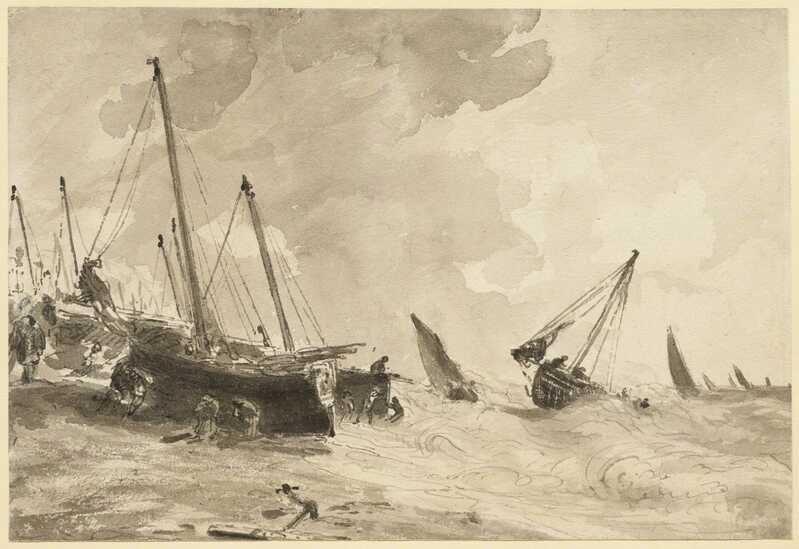
John Constable | Shipping in a Stormy Sea at Brighton (1824) | Artsy
"Shipping in a Stormy Sea at Brighton"
by John Constable

September 16th, 1936

To Mr. George Constable.

My Dear Friend, It is a very long time since I have written to you, or since I have had the pleasure of hearing from you. I am anxious to know how you and Mrs. Constable and all your family are, and what have been your occupations in the way of the arts, in antiquities, and in natural history. My dear John [the artist's oldest son] is always engrossed with some study or other. He is remarkably well, and is wholly devoted to Latin and Greek. I know not, nor does he know himself exactly what he will ultimately be, but either a clergyman or a physician. He is brushing up for Cambridge; this I regret, but it is a selfish feeling; I cannot bear to part with him.* I live a life of more solitude than you would suspect for the midst of London, and in such a pursuit, so wide a field as the arts.

My son Charles is returned from the East Indies; the voyage has been a hard one, but it is all for the best. All his visionary and poetic ideas of the sea and a seaman's life are fled, the reality only remains, and a sad thing the reality is. But in the huge floating mass there is an order, and an habitual good conduct, which must be of advantage to a youth of ardent mind, and one who has never been controlled. Charley is preparing for another voyage, and the ship sails in the middle of November for China.**

I must go into Suffolk, and take my sailor boy with me... I have lately painted a 'Heath' that I prefer to any of my former efforts; it is about two feet six, painted for a very old friend, an amateur, who well knows how to appreciate it, for I cannot paint down to ignorance... I have never seen such scenery as your country affords; I prefer it to any other for my pictures, woods, lanes, single trees, rivers, cottages, barns, mills, and, above all, such beautiful heath scenery.'""

To be continued

(Excerpts from "John Constable, R.A." by Robert George Windsor-Clive.)

Addendum

* John decided to become a physician, but as part of his studies attended to a patient with scarlet fever, sadly contracting the disease himself and dying from it. His father though had died before this so did not suffer this great grief.

** Charles Constable entered the East India Company's service, and was employed for many years in command of a smart brig upon the survey of the Persian Gulf. On the Imperial Government taking over the Indian Navy he retired with the rank of Commander, R.N.


Saturday, September 13, 2025

John Constable: The Lectures

"Wivenhoe Park, Essex" by John Constable
"In the summer of 1833 John Constable made his début as a lecturer, taking as his subject 'An Outline of the History of Landscape Painting.' He jokingly alluded to his new role in a letter to Charles Leslie in these words, 'Remember that I play the part of Punch on Monday, at eight, at the Assembly Rooms at Hampstead.' Leslie tells us that this and the other lectures he afterwards delivered at the Royal Institution and at Worcester were never written out. Constable depended upon slight notes only, and upon copies and engravings of the pictures to which he alluded. These he found sufficient. Many of his friends urged him to commit them to paper, and perhaps he intended to amplify them at his leisure, but he never did.

In his first lecture he traced landscape art from the specimens found upon the walls of Herculaneum and Pompeii, of a purely decorative kind, through the earliest painters of the Renaissance, to the illuminated manuscripts of the thirteenth and fourteenth centuries to the maturer years of the great Italian school. From thence he passed to the Poussins, Claude Lorraine, and the Flemish and Dutch masters. At this point landscape art rapidly declined and for nearly a whole century it lived upon the mannered and feeble imitations of past tradition. From this degraded state the revival of healthy landscape painting was mainly due to the English. This is a brief summary of his talk, which was afterwards developed into a series of four delivered at the Royal Institution in Albemarle Street.

In October 1835 Constable delivered three lectures at Worcester. In preparation for this he wrote: 'It will be more agreeable to myself to lecture in morning, as my tables and specimens can be better seen, and I hope it is now so planned... We must be early in the morning on Tuesday, so that we can get the room ready and a cloth hung up. My four sheets of double elephant [paper], about ten feet in height, and a few things besides.' One purpose of his lectures was to teach his audience that a close study of nature must come before its translation into any ideal form."

To be continued

(Excerpts from "John Constable, R.A." by Robert George Windsor-Clive.)

Thursday, September 11, 2025

John Constable: Paintings of the Burning of Parliament

"Fire in London, Seen from Hampstead"
John Constable

"Fire in London, Seen from Hampstead"
attributed to John Constable

"On October 16, 1834, a devastating fire broke out in the Palace of Westminster after the burning of old wooden tally sticks in underfloor stoves ignited the panelling.

The fire was a massive spectacle, attracting thousands of onlookers, including artists like John Constable and J.M.W. Turner. When the old Palace caught fire, most of London turned out to watch the flames. John Constable was in a cab with his two eldest sons, stuck in a jam on Westminster Bridge, from where he painted this Fire Sketch (1834), showing the north end of the building ablaze. 

The evening of the 31st he spent with me, and while describing the fire, he drew with a pen on half a sheet of letter paper, Westminster Hall, as it showed itself during the conflagration. Blotting the light and shade with ink, which he rubbed with his finger where he wished it to be lightest. He then, on another half-sheet, added the towers to the abbey, and that of St. Margaret's Church, and the papers, being joined, form a very grand sketch of the whole scene."

"Along with thousands of other spectators, J.M.W. Turner himself witnessed the Burning of Parliament from the south bank of the River Thames, opposite Westminster. He made sketches using both pencil and watercolour in two sketchbooks from different vantage points, including from a rented boat, although it is unclear that the sketches were made instantly, en plein air. The sketchbooks were left by Turner to the National Gallery as part of the Turner Bequest and are now held by the Tate Gallery. Some other sketches in Turner's sketchbooks, previously thought to also show the Burning of Parliament, have been reassessed and may be sketches of the fire that destroyed the Grand Storehouse at the Tower of London on 30 October 1841."

"The Burning of the Houses of Lords and Commons"
by J.M.W. Turner

"The Burning of the Houses of Lords and Commons"
by J.M.W. Turner
To be continued

(Excerpts from "Life and Letters of John Constable, R.A." by Charles Robert Leslie, and Wikipedia's article "The Burning of the House of Lords and Commons.")


Wednesday, September 10, 2025

John Constable: Observations

"Cottages on High Ground," watercolor sketch
by John Constable

"While at Petworth, where John Constable spent a fortnight, he filled a large book with sketches in pencil and watercolors, some of which he finished very highly. It was on this occasion only that, as an inmate of the same house, I had an opportunity of witnessing his habits. 

He rose early, and had often made some beautiful sketch in the park before breakfast. On going into his room one morning, and not aware that he had yet been out of it, I found him setting some of these sketches with isinglass. His dressing table was covered with flowers, feathers of birds, and pieces of bark with lichens and mosses adhering to them, which he had brought home for the sake of their beautiful tints. Mr. George Constable told me that, while on the visit to him, Constable brought from Fittleworth Common at least a dozen different specimens of sand and earth, of colours from pale to deep yellow, and of light reddish hues to tints almost crimson. The richness of these colours contrasted with the deep greens of the furze and other vegetation on this picturesque heath, delighted him exceedingly, and he carried these earths home carefully preserved in bottles, and also many fragments of the variously-coloured stone. In passing, with Mr. G. Constable, some slimy posts near an old mill, he said, 'I with you could cut off and send their tops to me.'"

To be continued

(Excerpts from "Life and Letters of John Constable, R.A." by Charles Robert Leslie.)

Tuesday, September 9, 2025

John Constable: From Sketch to Finished Work


"Hadleigh Castle, Mouth of the Thames - Morning after
a Stormy Night, 1829" by John Constable
"Constable's sketches include studies from nature showing motifs such as a portion of landscape and various effects of light, shade or weather. Some sketches were made in the studio as a first draft for a composition – however, Constable was unique in making full-size studio sketches in preparation for an exhibition painting, like his full-scale oil sketch for The Hay Wain. Studies made directly from nature were sometimes revised later in the studio – provided with a sufficient level of finish, they were judged to be suitable for exhibition and sale. 

When working outdoors, Constable painted on fragments of canvas, millboard or homemade paper. As he explained to a friend in 1825, his oil sketches 'were done in the lid of my box on my knees as usual'. In his open-air oil sketches, Constable applied colour in a variety of ways – rich impasto (thickly applied paint) and glazes (translucent oil paint), heavy dots of bright colour and light touches of pure white. Quick strokes with a brush bearing only a small amount of paint gave a dappled 'dry brush' effect, allowing the colours underneath to show through.

Constable transformed the genre of oil sketching from one used for recording landscape motifs to a means of capturing transient effects of light and weather. When his daughter Isabel gave the oil sketches remaining with the family to the South Kensington Museum (now the V&A) in 1888, they were aptly described by a reviewer in the London Standard as 'brilliant transcriptions of the thing of the moment – Nature caught in the very act'."

To be continued

(Shared from a blogpost on the Victoria & Albert Museum: https://www.vam.ac.uk/articles/john-constables-sketches/ )


Monday, September 8, 2025

John Constable: At Fifty-Six

"Study of Trees" by John Constable
"In a note, written in the early part of 1833, John Constable wrote: 'It is time, at fifty-six, to begin, at least, to know one's self - and I do know what I am not...' He then spoke of the qualities at which he chiefly aimed in his pictures: 'light - dews - breezes - blooms - and freshness, not one of which has yet been perfected on the canvas of any painter in the world.'

Constable's technical knowledge of painting probably equaled, if it did not exceed, that of most men of his day. He always had a large store, in the form of powder, chiefly of the various shades of ochres, madders, ultramarine, and the lovely greys known as ultramarine ash. He also to obtain a full liquid touch used what is called fat oil i.e., cold drawn linseed oil, which, after long exposure to light in an open vessel, had become bleached in colour with the thickness and drying qualities of megilp [a gel].

In February 1834 Constable had another and very painful illness, a severe attack of acute rheumatic fever, which lasted for the greater part of two months. In the early part of this period his suffering was very great. All the joints became the seat of the disease two or three times over and the paint and the fever were the most aggravated kind. He was never quite well after this severe illness, and its effects were felt by him and showed themselves in his looks ever afterwards.

His illness disabled him from sending any large work this year to the Academy, where he exhibited drawings only - three in watercolours and a large drawing in lead pencil, 'A Study of Trees Made in the Grounds of Charles Holford, Esq., at Hampstead.'"

To be continued

(Excerpts from "Life and Letters of John Constable, R.A." by Charles Robert Leslie.)

Saturday, September 6, 2025

John Constable: Competition at the Academy

"The Red Buoy" by J.M.W. Turner
"At the Royal Academy exhibition in 1832, John Constable and J.M.W. Turner were assigned places alongside each other in one of the main galleries. Constable had been working on ‘The Opening of Waterloo Bridge’ for fifteen years. In the days before the exhibition, artists were allowed to apply a final coat to their paintings as they hung on the gallery walls. And so Constable painstakingly set about his finishing touches." 

"In his autobiography Constable related how Turner's picture was grey with no positive colour in it. Constable's 'Waterloo' seemed as if painted with liquid gold and silver, and Turner came several times into the room while he was brightening with vermilion and lake the decorations and flags of the city barges. Turner stood behind, looking from the 'Waterloo' to his own picture, and at last brought his palette from the great room where he was touching another picture, and putting a round daub of re-lead somewhat bigger than a shilling on his grey sea, went away without saying a word. The intensity of the red lead, made more vivid by the coolness of his picture, caused even the vermilion and lake of Constable to look weak. He said, 'He has been here, and fired a gun!'

Turner did not come again into the room for a day and a half, and then, in the last moments allowed for painting, he glazed the scarlet seal on his picture and shaped it into a buoy - and thus, 'The Red Buoy' was created.

The critics agreed that Turner’s simpler, more restrained work made ‘The Opening of Waterloo Bridge’ look complex, fussy and ostentatious. The exhibition was a disaster for Constable."

To be continued

(Excerpts from "Life and Letters of John Constable, R.A." by Charles Robert Leslie and a blogpost by Jim Carroll.) 


Friday, September 5, 2025

John Constable: The Committee of Arrangement of the Exhibition


"Dell in Helmingham Park" by John Constable
"As a newly-elected Academician, John Constable was now on the Committee of Arrangement of the Exhibition, and, in a note to Mr. Lane, he says: 'I am sadly harassed, and not being able to call on you is most vexatious. I cannot go out lest my picture and my fire should go out too... I shall be overwhelmed with pictures, especially portraits, the painters of them all believing they can easily fill the shoes of Lawrence.'

In a note to me, written soon after, he says, 'I regret the entire confinement I have been in since I saw you. My picture has been, and is, plaguing me exceedingly, for it is always impossible to know what a picture really wants till it comes to the last. However, it shall go. It would amuse you to see how I am best. I have poets, earls, dukes, and even royalty at my feet. All painted canvas, of course.' His own pictures this year, 1830, were the 'Dell in Helmingham Park,' a small landscape, and 'A View of Hampstead Heath.'

While assisting in the arrangement, he found much trouble from the excessive size of some of the frames, and on remonstrating with an exhibitor on this point, who defended himself by saying that his frames were made exactly on the pattern of those of Sir Thomas Lawrence, he could not help replying, 'It is very easy to imitate Lawrence in his frames!' 

I have often observed, with surprise, how readily Constable would make alterations in his pictures by the advice of persons of very little judgment. While finishing the picture of 'The Dell,' he was one day beset with a great many suggestions from a very shallow source, and after adopting some of them he felt inclined to make a stand, which he did by saying to his adviser, 'Very true, but don't you see that I might go on and make this picture so good that it would be good for nothing?'"

To be continued

(Excerpts from "Life and Letters of John Constable, R.A." by Charles Robert Leslie.)

Thursday, September 4, 2025

John Constable: Sir Thomas Lawrence

"The 4th Earl of Aberdeen" by Thomas Lawrence
"John Constable, although always on friendly terms, had never been very intimate with Sir Thomas Lawrence, but he felt, in common with every artist in the kingdom, the magnitude of the loss of so eminent a painter, cut off with such apparent suddenness; at a time, too, when he was pursuing his art with all the energy of youth, though in his sixty-fifth year, and when, indeed, so far from betraying any diminution of power, he seemed to be improving on himself. This, I think, was acknowledged by all who had an opportunity of seeing the scarcely-finished, but very fine, portrait of the Earl of Aberdeen in the exhibition at the Academy that followed the death of its President.

When the painting materials of Sir Thomas were sold, Constable purchased a palette which had belonged to Sir Joshua Reynolds, and had been given by him to Sir George Beaumont, who gave it to Lawrence. He presented this interesting relic to the Academy, with its history inscribed on a silver plate inlaid upon it."

To be continued

(Excerpts from "Life and Letters of John Constable, R.A." by Charles Robert Leslie.)

Wednesday, September 3, 2025

John Constable: Approaches to Landscape Painting

"View on the Orwell near Ipswitch" in "English Landscape"
by John Constable
"John Constable was now engaged in preparing the 'English Landscape' for publication, having secured the valuable assistance of Mr. David Lucas, and it led to the magnificent engravings that gentleman afterwards executed of 'The Corn Field,' 'The Lock,' which Reynolds had contemplated, and the 'Salisbury Cathedral from the Meadows,' on a large scale, and the 'Stratford Mill' and 'Hadleigh Castle' of a lesser size. 

A prospectus of the 'English Landscape' was printed, saying, 'It is the desire of the Author in this publication to increase the interest for, and promote the study of, the rural scenery of England, with all its endearing associations, and even in its most simple localities; of England with her climate of more than vernal freshness, in whose summer skies and rich autumnal clouds, 'in thousand liveries dight,' the observer of nature may daily watch her endless varieties of effect.'

He was by this time fully aware of the obstacles that existed to a just estimation of his art, and he drew up a preface to his work, in which the following passage seems to me to be a true statement of the case between the public and himself:

'In art, there are two modes by which men aim at distinction. In the one by a careful application to what others have accomplished, the artist imitates their works, or selects and combines their various beauties; in the other, he seeks excellence at its primitive source - nature. In the first he forms a style upon the study of pictures, and produces either imitative or eclectic art; in the second, by a close observation of nature, he discovers qualities existing in her which has never been portrayed before, and thus forms a style which is original. The results of the one mode, as they repeat that with which the eye is already familiar, are soon recognized and estimated, while the advances of the artist in a new path must necessarily be slow, for few are able to judge of that which deviates from the usual course, or are qualified to appreciate original studies.'

To be continued

(Excerpts from "Life and Letters of John Constable, R.A." by Charles Robert Leslie.)

Tuesday, September 2, 2025

John Constable: Royal Academician

"Hadleigh Castle," Constable's entry in the
Royal Academy Exhibition, 1829

"On the 10th of February John Constable was elected an Academician. Wilkie, who had been for some time abroad, told me that when he saw Constable's pictures in the Louvre, he could not understand why the painter of such magnificent works had not long been a full member of the Academy. 

John Fisher wrote him: 'Although I fully expected the event, your not telling me that you are an Academician gave me the greatest pleasure. Your rewards are at last beginning to flow in upon you, although (as everything is ordained in a state of trail) the painful is mixed with the sweet...'

Constable called, according to custom, after the honour that had just been conferred on him, to pay his respects to Sir Thomas Lawrence, who did not conceal from his visitor that he considered him peculiarly fortunate in being chosen an Academician at a time when there were historical painters of great merit on the list of candidates.

So kind-hearted a man as Lawrence could have no intention to give pain, but their tastes ran in directions so widely different, and the President, who attached great importance to subject, and considered high art to be inseparable from historical art, had never been led to pay sufficient attention to Constable's pictures to become impressed with their real merit, and there can be not doubt but that he thought the painter of the humblest class of landscape, was as much surprised at the honour just conferred on him as he was himself. 

Constable was well aware that the opinions of Sir Thomas were the fashionable ones. He felt the pain thus unconsciously inflicted, and his replay intimated that he looked upon his election as an act of justice rather than favour."

To be continued

(Excerpts from "Life and Letters of John Constable, R.A." by Charles Robert Leslie.)


Monday, September 1, 2025

John Constable: Maria Constable's Death

"Maria Constable with Two of Her Children," a quick
sketch by John Constable, ca. 1820
John Constable wrote on the 22nd of August, 1828: "I believe Mrs. Constable to be gaining ground. Her cough is pretty well gone and she has some appetite, and the nightly perspirations are, in a great measure, ceased. All this must be good, and I am a great deal cheered. Still I am anxious - she is so sadly thin and weak. I am determined to try and get her out..."

But her sufferings, which she endured with that entire resignation to the will of Providence that she had shown under every circumstance of her life, were occasioned by pulmonary consumption [tuberculosis]. I was at Hampstead a few days before she breathed her last. She was then on a sofa in their cheerful parlour, and although Constable appeared in his usual spirits in her presence, yet before I left the house he took me into another room, wrung my hand, and burst into tears, with speaking. She died on the 23rd of November at the age of 40.  

From this time to the end of his life Constable never ceased to wear mourning. He returned with his seven children to his house in Charlotte Street, but retained the one in Well Walk, his last residence with his wife, as an occasional residence.

Almost three months later on the 10th of February, he was elected an Academician. Much as he was pleased at the attainment of this honour, he could not help saying sadly, 'It has been delayed until I am solitary, and cannot impart it.'"

To be continued

(Excerpts from "Life and Letters of John Constable, R.A." by Charles Robert Leslie.)